

Brothers and sisters I have none, but that man’s father is my father’s son. Who am I?
— ancient riddle
On April 28th, futurism.com published an article titled “Scientists Experimenting With Quantum Effect That Some Fear Could Cause Chain Reaction That Ends Entire Universe”.
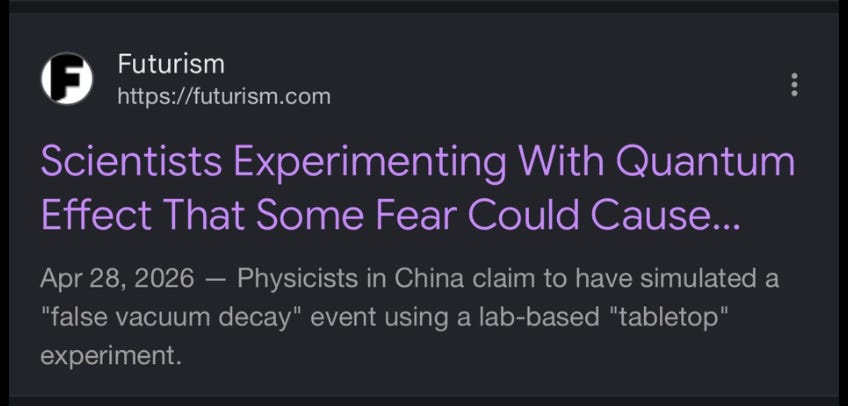
A reader who browses this headline and snippet could be forgiven for thinking that reckless scientists in China are putting the entire universe in danger.
The content of the article explains that scientists are experimenting on something called “Rydberg atoms”, which are not dangerous in themselves, but might teach us more about the actually dangerous thing, which is called a “false vacuum decay”. In other words, no physicist is putting the world at risk (that I’m aware of). But what if the most clickbaity interpretation of this article was correct, and physicists really were toying with fundamental forces with unprecedented destructive power—what should we believe then? Could physicists—or anything else—really destroy the entire universe?
The universe has already lasted 13.7 billion years or so. Surely it’s going to last another few hundred million years at least.
Right?
“You can set the quantum physics aside,” some philosophers will argue, “Newfangled technological bombs or not, the universe is safe.”
And there are also those who will argue the exact opposite: New technology or not, Doomsday is nigh.
Depending on how it’s framed, “Doomsday” here refers to either the extinction of humanity or the extinction of all conscious observers. This may not imply the destruction of the entire universe, but more on that in a bit.
The “Doomsday Argument” is in a class of hypothetical alongside “Boltzmann brains” and “the presumptuous philosopher”, all of which are built atop the same single assumption.
I call this assumption the “self-observation remarkability bias”, and it is subtly devious, absolutely specious, and when taken to its logical conclusion, utterly absurd.
The Doomsday Argument
You are presented a guessing game involving an ordered deck of cards. The deck can be any size N between 1 to 100, but you don’t actually get to see the deck. A random card will be chosen from the deck and shown to you. If the fifth card is drawn (which we can call K = 5), how large might you expect the deck to be, on average? If the seventy-fifth card is drawn (K = 75), does that make the chance of a maximum deck size (N = 100) higher than if the twenty-fifth had been drawn?
The answer to that second question is yes. Larger draws make larger deck sizes more likely, since they eliminate the possibility of smaller deck sizes.
Smaller draws do the opposite. Before any card is drawn, the chance of any deck size is 1%. After drawing the very first card, K = 1, the chance that you drew that card because you had to draw that card, because that was the only card available, increases. (Similarly, the chance that you drew it as a 50% shot between the choice of two cards also increases, though not as much.)
Doing the math will show that the chance of N = 1 jumps all the way up to 19%.
Observations give us probabilistic evidence towards the possible worlds in which those observations were more likely—e.g., smaller deck sizes for smaller card draws.
The Doomsday argument takes the same dynamic and applies it to the human population:
There’s a 1/N chance of you being any particular person in history.
Therefore the chance of being in the first K people is only K/N. Once you observe yourself to be the Kth person ever, then following a similar line of math as with the deck of cards, the most likely N becomes roughly 2*K.
However, the human population has been growing exponentially rather than linearly. If our total population is likely to be in the range of 2*K, then that exponential growth means we’ll hit that bound soon.
The implication being: If there’s only so many humans left, then something will have to kill us all off. Maybe a black hole, or maybe a quantum bomb that destroys the whole universe. Every possible Doomsday scenario should be ascribed a higher probability than we would otherwise, without the Doomsday Argument.
Having this explained to her, my wife couldn’t make any sense of this logic. How can the count of humans who’ve existed so far matter to whether a black hole or false vacuum will form?
I agree with her instincts on this: The argument doesn’t make sense. Yet it’s been taken seriously by philosophers for decades, because it is far from obvious how to refute.
Of the three steps outlined above, I believe that step 2 is solid. I’ve checked the math myself, though I’m admittedly prone to error when it comes to math—I encourage those who are inclined to double check the math themselves.
Step 3 is fun because it makes the whole argument more dramatic, but it’s debatable and ultimately unnecessary. Whether humans would be expected to die very very soon, thanks to the extrapolation from exponential growth, or whether that end we’d be expected to last just a bit longer, as our population follows a sigmoidal curve, doesn’t change the fundamental prediction: Whatever K population we currently have, the Doomsday Argument will predict a grand total of 2*K humans to exist in all of space and time.
And honestly, 2*K doesn’t seem like an unreasonable prediction. Maybe there’s truth to the argument after all. Surely it won’t lead to any-
Utter Absurdity
Let’s rewind the clock about 300,000 years—or maybe more accurately for this scenario, 6,000 years—and let’s forget about the theory of evolution or the genetic quagmire that would wreak havoc upon a population from intense inbreeding.
Adam and Eve.
In the Garden of Eden, the couple meet their fabled serpent. They learn of carnal temptation, partake in Biblical acquaintanceship, and then face God’s judgement. Unable to handle His Great and Terrifying Disappointment, Eve flees and begins her journey of pregnancy alone. Adam, on the other hand, is arrogant and unperturbed. He neither chases after Eve nor dissents against God. Instead he lounges at home, eating apples and chatting with his new scaley friend.
In captivity, a common garter snake can live up to twenty years. This serpent of Eden ends up surviving only another two months, when an eagle happens by and eats him. Adam tries to befriend the eagle, but of all the world’s animals, only the serpent had been imbued by the grace of God to speak proto-Semitic. As such, Adam is left alone with only his thoughts and his apples for the next one hundred years.
When Eve at last decides to return, she brings a giant family in tow. An overwhelmed Adam sits in shock as she tells her tale: How she traveled miles every day, subsisting mostly off rainwater, barely edible berries, and mildly poisonous mushrooms. How she befriended a wolf pack whose warm bodies helped her survive the harsh winter. How she birthed a miraculous octuplet of daughters, each of whom was forced to learn to hunt as soon as walk—but each of whom grew up happy, surrounded by lupine guardians and sisterly affection.
Eve describes next how each of her daughters and granddaughters likewise experienced parthenogeneses, God granting them a healthy amount of genetic variety (and the ability for humanity to jumpstart with only first-cousins level of incest). She describes the flourishing of her family, then has each of her fifty great-granddaughters and fifty great-grandsons introduce themselves to Adam.
Eve says: “I dream of a thriving humanity that will venture through all the jungles and deserts and oceans of this world, spreading our roots. You, Adam, will have been the first of thousands. Maybe even perhaps the first of billions.”
Adam, who’s grown visibly uncomfortable and increasingly shifty during all this, replies: “Hah! You really believe me to expect the evidence of my lying eyes? If it were true that I had fifty male descendants, then there would be a less than one-in-fifty chance of me being me, for I could have been born any one of them! Much more likely that all this is a ruse pulled by God the Deceiver and that I have no male descendants. You expect me to believe that there will be billions of humans? Then the chance of me having been the first human would be one in billions. In fact, think about this: God promises a future that will last billions of years, if not forever. What chance could I have had to be alive right now, during this mere century, rather than at any other point in the history of time? Essentially zero, unless I were in fact immortal. This is the most probabilistic explanation of my observations: These children are fake. You are fake. Everything in this universe are but figments of my imagination—me, the only thing that’s real, forever and always.”
But Adam, quite worked up and over a century old, goes into cardiac arrest at that exact moment and dies a minute later. Eve buries Adam in the Garden of Eden and marks his grave with a single upright stick, because neither gravestones nor crosses had yet been invented.
Adam tries to argue that certain things about the future must be true, based on an understanding of himself as being a random draw among events that haven’t happened yet, and which may or may not even happen.
In other words: Adam ends up forming beliefs about the size of humanity’s future population based on his belief about his place within the scope of humanity’s past and future population.
It’s circular logic.
We can start building the right intuition that avoids this circularity by recognizing that Adam’s first rank isn’t any more remarkable than someone being the 42nd human to exist, or the 6,283,185,307th human. That distinguishes the Adam example from the deck sizes example, in which smaller card draws are remarkable for being more likely with smaller deck sizes, and larger card draws are remarkable for only being possible with larger deck sizes.
If God told Adam, “I created a billion different universes, each with a different human population across all time, from 1 to a billion. I then picked a random universe, and picked a random body throughout history inside that universe, and plopped your soul into that body,” then we’d have a situation analogous to the deck of cards: Adam should indeed predict smaller future populations.
Lacking such an explanation from God Himself, the Doomsday Argument falters. How exactly? Earlier, I presented the Doomsday Argument in three steps. The second step was unassailable and the third step irrelevant.
The first step was this: “(Given a total population of N) there’s a 1/N chance of you being any particular person in history”. Or rephrased:
P(I am the Kth human | past-and-future population has size N) = 1 / N
This is an incorrect premise1.
Except… If 1/N is wrong, then what’s the correct value? What was the chance of me being me, or you being you, or Adam having been first?
The Mistaken Assumption
Realistically, I don’t think there’s anybody in history we can point to as the “first” human. Evolution would’ve made the boundary too fuzzy. How many individuals would’ve blurred the definitions between Homo heidelbergensis than Homo sapiens? In a broader sense, at what point were we more monkey than man?
But let’s say we drew an arbitrary line and defined the exact moment in time “humanity” began. Man #1 gets to be known as “Adam”, woman #1 gets to be known as “Eve”, and I hereby bequeath upon the 42nd man the name “Dams Ouglas”.
We want to know: What’s the chance that a given person has their rank K? Every K should have the same chance, because no position is more remarkable than any other, which means this question is equivalent to asking: What’s the chance that “Dams” was 42nd?
P(“Dams” was 42nd | total population of N) = ?
The answer:
P(“Dams” was 42nd | total population of N) = P(“Dams” was 42nd)
And:
P(“Dams” was 42nd) = 1
I don’t mean 1%. This is a one, as in 100% absolute certainty (THAT IS—contingent on assuming the setup is as described. If you’re a Bayesian and the phrase “absolute certainty” is throwing up red flags, check this2 footnote.)
That… might violate some intuitions.
It’s natural to ask questions about the relative fortunes or misfortunes around the circumstances of one’s birth. Questions which will have answers with probability less than 1. For instance—to pull a completely random question out of my ass3, with no personal salience whatsoever—I might ask: “What’s the chance, if I were a random American millennial, that I’d be diagnosed with colorectal cancer before 35?” (Less than 1 in 2,000.) Or: “What’s the chance, if I were a random American millennial, that said cancer would metastasize by 40?” (Again, roughly 1 in 2,000.)
The conditional clauses are doing important work here. If I omit them and instead only ask, “What was the chance I’d be diagnosed with CRC by age 35?” the answer would be 1.
In the exact same way, the chance of Dams being 42nd was 1. That’s because both “Dams” and “42nd person” are references that point to the same entity. The subject and object are just different names for the same person.
When we ask something like, “If God were to choose a random human from across all time, what’s the chance he’d happen to choose Dams?”, then we end up with a different subject (a random selection of human) from object (Dams).
Your own existence, once observed, is a given4.
(If you’re still not convinced, I’ve listed two more examples in the Addendum at the bottom of this post.)
Why do philosophers keep getting this wrong?
Because references (AKA “pointers”) are hard!
This is a well-known fact to any software developer who’s programmed in C, and also many riddlemasters and magicians. The riddle I presented at the beginning of this essay follows the format, “It seems like I’m referring to different individuals, but actually I’m referring to the same one,” as does Lewis Carroll’s classic problem involving the nominal ambiguity of familial relationships:
The Governor of Kgovjni plans on hosting a small dinner party and invites his father’s brother-in-law, his brother’s father-in-law, his father-in-law’s brother, and his brother-in-law’s father. How many guests will he have?
(The answer can be as small as one.)
In the same vein, “these two cards seem like they have no relation, but actually they’re the same card” is the basic format of about half the card tricks I’ve ever learned, like this one:
The Anti-Doomsday Argument
It’s tempting to think that no matter what maniacal technologies we develop, we’ll never destroy the universe nor the planet: They’ve been around too long, and have surely seen worse than us. The worst we can do is destroy ourselves.
Is there merit to that idea, or might this be another argument built atop a faulty premise?
It’s certainly within the realm of plausibility, similar as it is to arguments like this:
Trees have been around a very long time.
In all that time, trees have never obliterated the planet.
Trees tend to remain treelike. It takes a long time for trees to evolve into non-treelike things.
Therefore, trees are unlikely to obliterate the planet any time soon.
I would hope that’s uncontroversial.
The important difference between humans and trees is not that we’re more destructive, but that our behaviors are demonstrably changing on an incredibly rapid timescale. We existed for a few hundred thousand years before inventing T.N.T., but then it took us only 82 more years to invent the atomic bomb.
When combined with one other observation, I believe we can conclude that humans are extremely unlikely to instantly destroy the entire universe, all at once—but any lesser degree of destruction might well be within our grasp, including instant destruction of the planet, or a chain-reaction that will eventually but not immediately destroy everything else.
The other observation is that of the universe’s unimaginable vastness. Astronomers estimate that the Milky Way contains around 100 to 400 billion stars, and even more incredible, that the universe likely contains somewhere in the range of 200 billion to 2 trillion galaxies.
So no matter how rare the existence of life, God only knows how many trillions of Earthlike planets might be out there, and how many trillions of alien species might exist with human or superhuman intelligence. If none of them ever managed to deliberately or accidentally destroy the entirety of the universe in a single instant, I think it’s fair to judge that such an act is flatly impossible.
However, with space being so large and difficult to traverse that we’ve yet to actually meet or even observe any aliens, we’re blind to what fates might eventually befall the typical alien species. Maybe the universe is littered with the desiccated husks of once-thriving civilizations who venture too far with scientific experimentation; maybe every black hole is the scorch mark of a quantum bomb.
So… Doomsday?
It was 1944 and Manhattan Project scientists needed to know how to safely test a nuclear detonation. J. Robert Oppenheimer argued that they needed a test whose scale would be “comparable with that contemplated for final use”. Brigadier General Groves was concerned—though not with safety5. He just wanted to make sure they didn’t waste their expensive plutonium.
The Trinity test proceeded in secrecy in the Jornada del Muerto desert (literally “Journey of Death”), about 35 miles away from the nearest city, though only about 13 miles away from the nearest ranchers.
They were confident with this margin of miles. Trinity would not wipe New Mexico off the map.
But how could they be so sure?
We might reason:
There’s a 1/100 chance that measurements are 100x off
There’s a 1/100 chance that calculations are 100x off
Combined with other such chances, there must be a larger than 1-in-a-10,000 chance of the test detonation ending up in horrific tragedy
The military might judge 1-in-10,000 to be an acceptably low risk, but I’m betting many New Mexicans would disagree.
The key to their confidence was the Square-cube law. All explosions, nuclear or not, scale as a cubic root rather than linearly: To cover twice as much radius, a bomb will need eight times as much energy. That meant the Manhattan Project scientists’ measurements could have been many orders of magnitude off, and the test bomb (codenamed “the gadget”) still wouldn’t have blasted past the ends of Joranda del Muerto.
It’s conceivable that in the future, some scientist will theorize a new type of super-efficient energy reactor that might usher in a new golden age of civilization and resource abundance, but with one minor potential drawback: The scientist also theorizes that this new process might instead trigger an explosion that would destroy half the planet.
In such a situation, the appropriate next step isn’t the weighing of potential gains against potential risks to determine whether to pursue this technology.
The best next step would be to do more science.
How should someone go about predicting the number of future humans? The same way you'd predict the death of an empire, or the direction of the stock market: with a great deal of work.
Manhattan Project scientists were able to develop extremely more confident probabilistic beliefs thanks to their knowledge of the Square-cube law. A good prediction about the impact of a quantum bomb will undoubtedly require deep knowledge of physics. A good prediction about near-future population sizes would involve deep knowledge about economics, politics, epidemiology, understanding the factors behind birth rate decline, and also the potential factors for birth rate escalation. A good prediction about distant-future population sizes would require deep scientific knowledge about likely extinction events and the feasibility of interplanetary or intergalactic colonization.
None of these begin with the assumption, “I’m a random draw from among all humans.” Though the fact of our existence is incredibly arbitrary (and a mystery), and without omniscience, our lives are dominated by randomness (deterministic universe or no), we are not “1/N” random. Our K ranks are what they are; they do not bear on what the future holds, whether humanity will soon face Doomsday, whether we’ll survive the next trillion years, or whether we’ll survive for all infinity.
All of that is an open question, because when the next possibility of Doomsday arises, it won’t be philosophers like me who can judge its probability. It’ll be the scientists.
Addendum: Extra examples
Example 1: Medals
You enter a twenty-person footrace. You don’t know how good the other competitors are, so you judge yourself to have an equal shot at any particular result, 1/20.
You win the Bronze! The organizers start handing out medals. After you receive yours, you remember: The organizers had previously stated how many people would receive medals, and it was either all of the top ten, or all twenty participants.
Now that you’ve received a medal, what’s the chance that one the top ten will receive one?
YGM: Event that you got this medal
N: Number of people who will receive a medal
P(N=20) = P(N=10) = 1/2
P(YGM | N=20) = 1
P(YGM | N=10) = 1/2
P(YGM) = 3/4
P(N=10 | YGM) = (1/2)*(1/2)/(3/4) = 1/3
This math mistakenly leads you to thinking that P(N=20) is now twice as likely, when actually it hasn’t changed.
The third place observation of receiving the bronze medal is identical in both possible worlds, so you gain no new knowledge from it6. P(You get Bronze) = 1/20, which changes all the math above. Or you could factor in that you’d be one of the fastest, and then P(YGM | N=10) would equal 1.
Example 2: Flash
A man checks his Amazon account and sees he’s been randomly selected to receive a reward of $5 store credit as part of a Black Friday promotion. He has no idea whether this promotion is targeting only the most loyal customers, or some specific test section of customers, or all of them. He imagines that whatever the case, the promotion must be pretty large, because otherwise the chance of him having been selected would’ve been low.
More numerous giveaway → more likely.
Flash is a speedster, the fastest in the world. He can be in Paris one second, New York the next.
He happens to see an advertisement for a free giveaway from a store doing a clearance sale, up to the first- VRRZ! POP! -and he’s already at the store, first in line. He didn’t bother to finish reading the advertisement, which may have finished “up to the first 50 customers in line” or “up to the first 9,999 customers” or anything else, who knows. While he waits for his free merch, he idly wonders how many others will show up in line behind him.
Is a more numerous giveaway more likely, as before?
Or is a smaller giveaway more likely, like with the deck of cards example, given that Flash happened to have been first?
Neither. A regular person might have reason to judge smaller giveaways more likely, but as soon as Flash had seen the ad, he was guaranteed to be first. P(K=1) = P(K=1 | N of any size) = 1. Therefore if he wants to judge the likelihood of the size of the line that will form behind him, he’ll have to depend on other factors.
Example 3
Which is why you don’t need the “SIA” or “SSA” to fix anything. Trying to build theories atop an incorrect assumption is just building castles of sand.
It’d be more accurate if I wrote Dams≜42nd. They are defined to be the same thing. And that means: Dams≜42nd ⟹ P(Dams=42nd | Assumptions)=1, where P(Assumptions)<1
Pun intended
Admittedly, an event being a given doesn’t force you into using P=1. Sometimes it’s useful to rewind and pretend you don’t know something, then calculate Bayesian updates to beliefs held prior to that observation, if for no other reason than to double-check your math.
In this case, though, what can we rewind to? “Cogito ergo sum” can be thought of as the very first observation an observer can make, antecedent to all else. We can only speculate about the nebulous before-time, the same way we can speculate about consciousness and ask questions like, “If God created M souls and N bodies, what’s the chance that a particular soul would end up in a particular body?” Such setups can result in Doomsday Argument analogs, but they assume things about God and the universe that might not be true. Assuming souls are randomly allotted to bodies is putting the cart before the God: more circular logic.
Fifteen years later, an article in The American Weekly described Oppenheimer’s fear about a chain reaction that might engulf the entire world, and how Nobel laureate Arthur Compton refused to allow the Trinity test to proceed unless they calculated a less than three-in-1-million chance it would vaporize the world. As described in this more recent and more accurate article, the reality was that after Oppenheimer’s initial concern, they soon reasoned that such a chain reaction would be impossible. Basically nothing to worry about.
Just as waking up gives you no new knowledge in the Sleeping Beauty problem.