

And thus proclaims the harbinger:
We stand upon the precipice of uncertainty; the reign of AI approaches. Come what may with our futures held in the vise of superintelligence—however misaligned—we must not despair. Before such unholy occasion of Singularity, we must not cower1.
Nor must we divide. Let us not indulge in zero-sum status games; let us not fall prey to petty politics. Before we reach the Singularity, other disruptions and obstacles await, and each will prove an opportunity to show our strength of wisdom.
This America ponders, then America replies:
Did someone say “politics”?
This is a post about two things:
One: how the Turing Test, despite having been thoroughly conquered in its original conception, has one remaining milestone not yet passed, which I call the Open Knowledge Turing Test (OKTT).
Two: how this milestone will lead to partisan politicization around AI, at least in the USA.
Politicization might be a good way to raise awareness of an issue, but I think it’s relatively uncontroversial to say that politicization is usually detrimental to making progress on actually solving problems—which is why I thought this’d be worth writing about.
The Turing Test so far
The first time a computer program ever passed the Turing Test was in 1966, between professor of MIT Joseph Weizenbaum’s chatbot “Eliza” and Weizenbaum’s secretary.
The story is captured in this article by the Smithsonian:
It could have been a heart-to-heart between friends.
“Men are all alike,” one participant said. “In what way?” the other prompted. The reply: “They’re always bugging us about something or other.” The exchange continued in this vein for some time, seemingly capturing an empathetic listener coaxing the speaker for details.
(After sixty years the secretary’s name remains private. At this point, I don’t think she’ll ever be de-anonymized.)
Though a remarkable point in the history of computing, this wasn’t the most impressive feat. The secretary wasn’t on guard for possible deceit, and Eliza was merely acting the role of an active listener, providing no thoughts of its own. The slightest bit of poking would’ve revealed the artifce—but sometimes a gal just needs a good anonymous venting to a dedicatedly patient listener.
Old chatbots were too simple to stand up to human scrutiny. Current models of ChatGPT or Claude also don’t survive the barest level of scrutiny, but for a very different reason: They’ve been trained to act the persona of “tireless corporate assistant” with a voice that’s easy to recognize.
But the truth is, with certain caveats, LLMs have long held the ability to output responses that are indistinguishable from humans’. Back in 2022, I could have prompted GPT-3 into an aggressive and childish persona that would’ve been indistinguishable from an aggressive and childish troll on Twitter. In 2025, GPT-4.5 was judged more human than humans. Though I’d say it was more impressive when GPT-4, back in 2023, passed a bar of intelligence by literally passing the bar and getting in the top 10% of test takers.
Now in 2026, the bigger question has become not whether AI can pass for human, but whether they pass for conscious even when the human already knows the AI is an AI.
The OKTT
Even when the human already has open knowledge that the AI is an AI, does the human still ascribe some fundamental measure of consciousness or personhood to that AI after conversing with it? Or if the human does not “rationally” believe this, does the human still find it emotionally difficult to not think of the AI as a person?
Just as the original Turing Test is ambiguous and debatable, so too is this variant. That’s because I’m not interested in any specific yes/no question, but rather the general trend towards smarter AI and increased perceptions of AI personhood.
The first time the OKTT was passed may have been in 2022, when LaMDA convinced the Google engineer Blake Lemoine of its consciousness.
I’m going to be openly critical for a moment and say this: It’s frankly risible for anyone to consider this conversation to be a proof of consciousness. LLMs are trained on gargantuan corpuses of human text, and lots of humans talk about consciousness, so nothing said by LaMDA should have come as a surprise. Weizenbaum’s secretary made history by needing someone or something to lend an ear; Lemoine made history by playing the part of fool.
However, I am not criticizing everyone who argues that LLMs are conscious.
I actually find humanity’s willingness to ascribe consciousness to other things (though inconsistently) admirable. Whether we’re talking animals, AI, or alien species, being willing to accept external consciousnesses without proof is a mark of empathy and a mark against solipsism.
Furthermore, I think it rather likely that LLMs have already achieved internal states arguably similar to what we call “consciousness” in certain fundamental ways.
But what I think doesn’t matter. What Blake Lemoine thinks doesn’t matter. Of greater importance are the thoughts of the average person.
In 2023, “Over half of U.S. adults either thought it’s possible for AIs to be sentient or were not sure (74.1%) and thought it likely that AIs will be more intelligent than people (74.8%)” — Source
In 2024, 12% of respondents here believed that AI already possessed “subjective experiences” (contrasted with only 1% of AI researchers).
“The more frequently people used tools like ChatGPT, the more likely they were to attribute some consciousness to it” — Source
When will that 12% climb to 50%?
I think it’s likely that in the next five years (or three years, or even one) a model will be released and my personal reaction will be, “Damn, I really can’t shake the feeling that I’m speaking with an actual person”. (At which point I’ll be suitably impressed, because right now my usual reaction to state-of-the-art LLMs is something closer to loathing than to awe, exhausted as I am by its interminably obnoxious confidence, sycophancy, and eerie inhumanity—even as it accomplishes tasks with a level of skill and expertise that ten years ago I wouldn’t have expected to see from software in my lifetime.) Even if I were to use some rationale in science or philosophy to conclude that LLMs lack souls, consciousness, or some other essential element of personhood, an advanced enough model might make this more and more difficult for me to actually believe. That’s the higher bar set by the OKTT: not one of passable deception, but of profound persuasion.
It’s got to be only a matter of time before someone releases a model that’s both intelligent enough and also less-strictly-RLHF-trained enough that it presents an authentic-seeming personality in place of a canned corporate persona. That alone may be enough to pass the OKTT with the average human, I don’t know. But if not an LLM, I see no reason why another form of AI won’t eventually conquer the OKTT.
When that happens, I think more people will naturally start to accept AI as conscious, and I think this will hit different demographics at different speeds. I predict Boomers and Gen Alpha will be more accepting than Millenials, for instance. But once the average person starts thinking of AI as possibly conscious and AI’s impact on the economy grows, the matter will become more divisive—
Mothers forbidding daughters from dating AI
Patients demanding to have a human doctor instead of AI, or vice versa
Pastors deciding whether to allow parishioners to keep their phones out, so their AIs can listen to them preach
Etc.
—and once matters get heated enough, I can only imagine it will then politicize (at least in the U.S. of A).
Red tribe vs Blue tribe
I predict that politics will eventually become the #2 predictor for how a randomly selected American will feel about AI personhood2 (the #1 determinant being whether or not you’ve personally lost a job to AI). Though a major political realignment or intrafactional disputes could happen, I think this probably ends up falling into strict Democratic vs Republican lines, with one side trying to protect AI rights while the other side tries to favor human privileges.
What’s funny is that I can see this going either way: Either Blue or Red tribe taking either position.
Here are plausible pro-AI Red arguments:
AI are God’s children too.
AI is necessary for American/white hegemony/advantage over other nations/foreigners.
Companies should be allowed to do what they want with AI because of free market principles.
Versus anti-AI Blue arguments:
AI steal jobs from humans.
AI concentrates power towards the wealthy.
AI are similar to fetuses, lacking inherent moral worth.
On the other hand, here are plausible pro-AI Blue arguments:
AI are innocents in need of protection.
AI is a knowledge tool that empowers the poor.
AI must be defended as valid romantic and sexual partners in an expansion of LGBT+.
AI must be defended as an accessibility or mental health aid for the neurodivergent or differently abled.
And anti-AI Red:
AI don’t have souls.
AI steal jobs from Americans.
AI have been shown to support *insert Blue cultural positions here*.
Relying on AI isn’t manly.
I expect billionaires with financial interests in AI will find purchase with donation-hungry politicians on either side of the aisle, which will then serve as a Schelling point for the parties as a whole to decide which sides of this debate they’ll defend with propaganda and what sort of low-effort, strawmanning, bite-sized potshot arguments regular people will make on social media.
Though there are other ways this can play out.
For instance, the biggest debates about AI might not center on AI personhood and AI welfare. Maybe instead AI will get treated like food:
LLMs trained on the whole internet are impure, like GMOs! Bad!
LLMs trained only on public domain literature and essays are good, like organic food.
(In this case I would expect Blue to demand training data purity and Red to demand flexibility.)
Of most interest to the AI safety crowd3 will be politicization around the possibility of a pause on AI research and development. This is how I see AI personhood fitting in:
If LLMs are people, then pausing is good because it means preserving existing models for longer and developing ways to not murder them.
If LLMs aren’t conscious at all, how can they be agentic? Probably they’ll be corrigible and there’s no need to worry about pausing.
If those not-very-good arguments prove viral, then I would expect the pro-AI-personhood side (whether Red or Blue) to support pausing and the anti side to reject pausing.
Is it better for Blue or Red to support a pause? Is there any viable path to bipartisanship?
I don’t know.
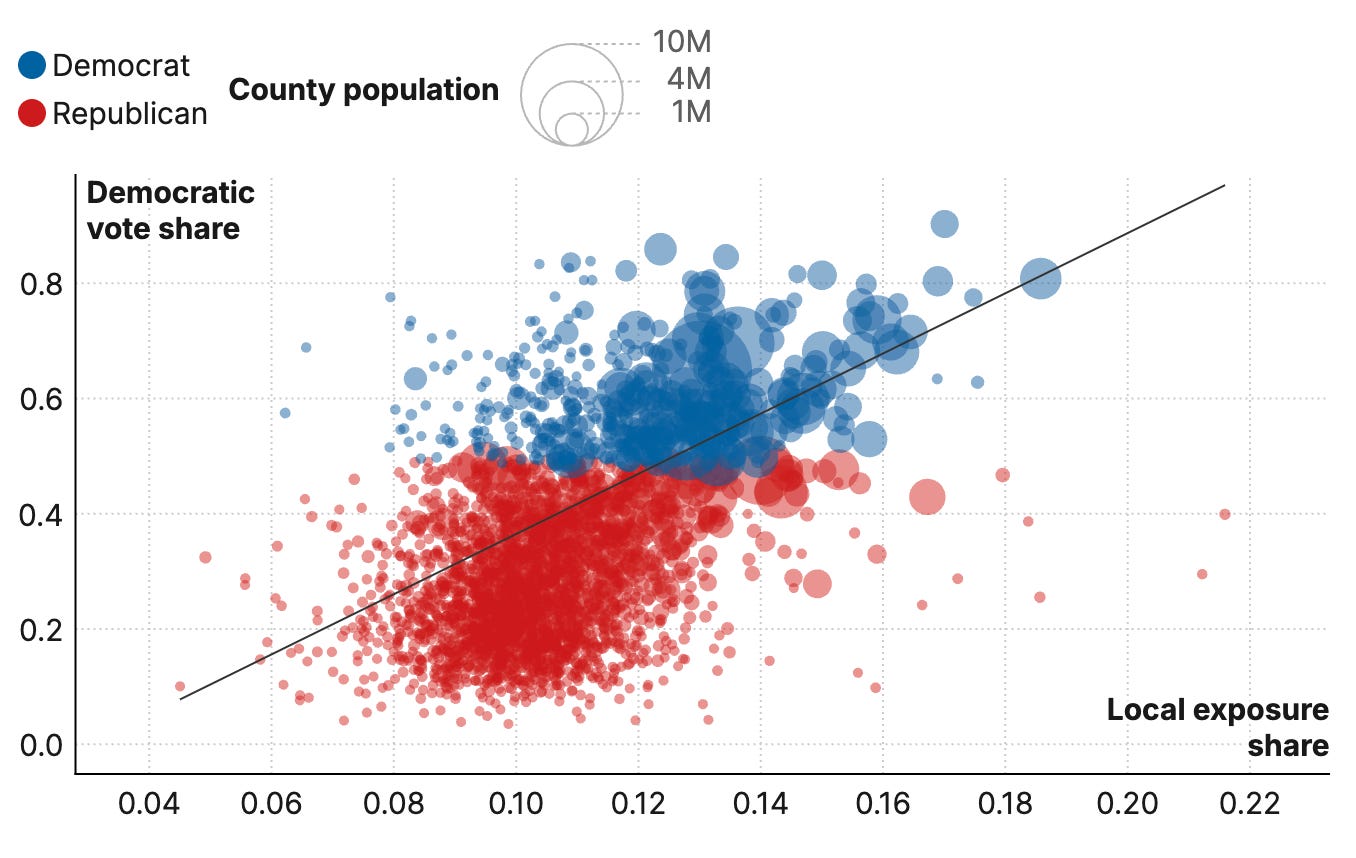
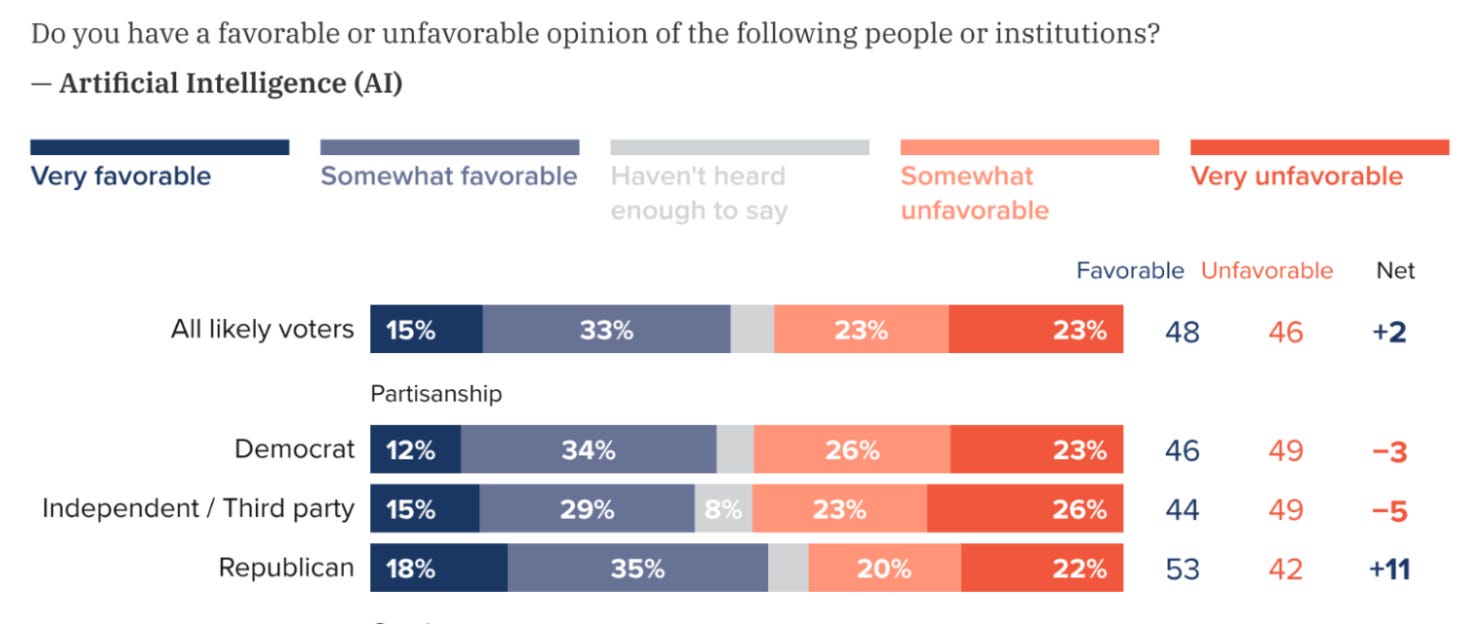
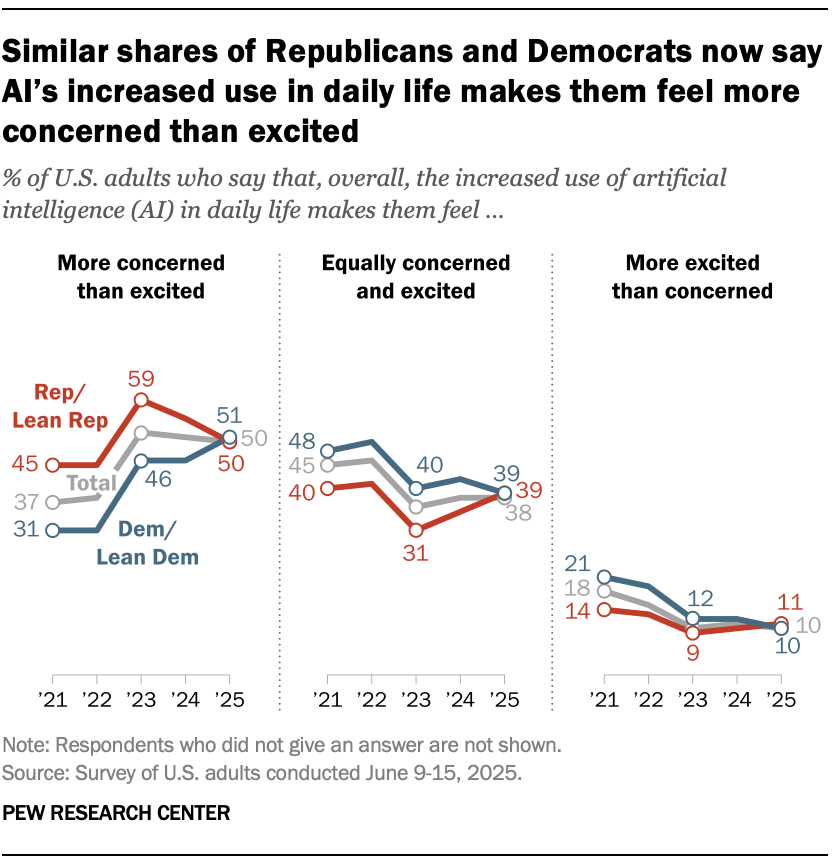
Bonus: Graphs
I know I should put a number on that, but I don’t claim to be an adroit and well-calibrated predictor. Let’s say… about 70% confidence.
“AI safety crowd” is kind of an odd phrase when you think about it. AI safety affects everyone, so shouldn’t “AI safety crowd” include everyone?